




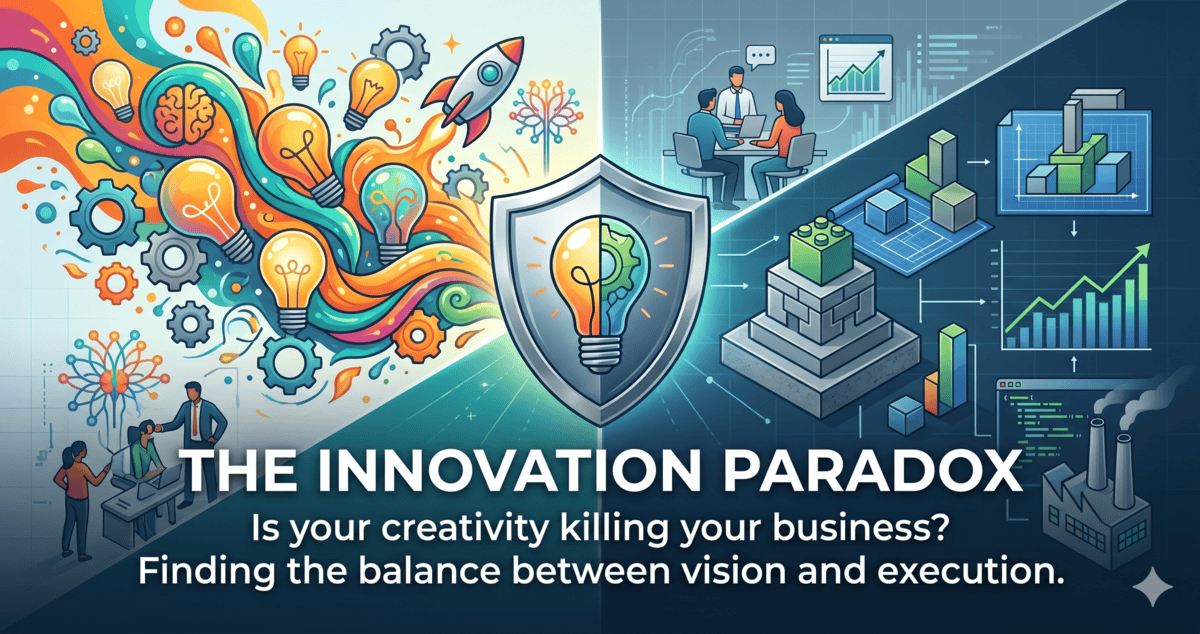
The Innovation Paradox
In the world of startups, marketing agencies, and software houses, the word “creative” has become the highest compliment. We have creative industries, creative directors, and endless workshops on design thinking. But let’s be frank, without marketing gloss: in business, creativity can be a fatal trap. While in art the creative process can be an end in itself, and a work doesn’t have to earn money, in business, the only ultimate measure of success is profit. For years, I myself was under the illusion that the next “brilliant idea” would save a project that was failing at the level of basic assumptions. Today, I know that creativity can provide a one-time cash injection, but sustained profit is built on boring meticulousness and repeatable systems.Oil vs. Engine: The Hierarchy of Business Needs
Imagine your business as a racing car. Creativity is like engine oil. It is essential for the mechanisms to run smoothly, to prevent seizing at high RPMs, and for the whole thing to work efficiently. But oil does not power the vehicle.
The engine consists of plans, procedures, strategies, and hard execution. They are what convert energy into real forward motion. You can have the most expensive, most innovative synthetic oil, but if you pour it into a leaky engine block without pistons, you won’t go anywhere. What’s worse, excess oil in a poorly constructed machine will only lead to leaks and a mess.
It is similar in architecture. Everyone admires the glass facade or the bold shape of a modern museum’s structure. However, what keeps that building upright during a storm are the reinforced concrete foundations, which are not visible in social media photos. You cannot cheat gravity with creativity. Neither can you cheat a business that has to pay for servers, taxes, and salaries.The Traps of “Overdoing It,” or When Creativity Harms
When does creativity stop helping and start sabotaging? As programmers and entrepreneurs, we often fall into three main traps:1. Overengineering: Architecture for the Sake of Architecture
Working in environments like Node.js or WordPress, it is easy to succumb to the temptation of “doing something better”. Instead of using a proven plugin or a simple module, we decide to write our own custom framework because “it will be more elegant”.
- Result: You create a system that no one else can handle. Your creativity generated technical debt, which will be paid for not only by you but also by your client. You solved a problem that did not exist, ignoring the real one: time-to-market.
2. Shiny Object Syndrome: Paralysis by Novelty
A creative mind is an idea generator that works 24/7. The problem arises when a new idea (shiny object) always seems better than the one you are currently implementing.
- Result: You have dozens of half-finished repositories, incomplete projects, and “revolutionary” marketing strategies that never saw the light of day. Creativity here becomes a form of procrastination—an escape from the difficult, artisan work of completing tasks.
3. Ignoring Data for the Sake of “Vision”
Visionaries rarely look at an Excel spreadsheet. They believe that their intuition is more important than user feedback or conversion rates.
- Example: You insist on a non-standard, “artistic” navigation on the website because it looks unique. Data shows that users are leaving because they don’t know how to get to the shopping cart. Creativity at this point works directly against your profit.
Business is a Craft, Not Inspiration
This statement hurts many because it strips company management of its aura of magic. But the truth is brutal: a craftsman doesn’t wait for inspiration to start work. He knows his tools, has procedures, and knows that repeatability is the key to quality.
In a craft, creativity appears at the very end, as the finishing touch. It should be the same in business:
- Foundation: Does it solve a real problem?
- Structure: What are the costs, margin, and reach channels?
- Process: How can we do this repeatedly without my involvement every minute?
- Creativity: How can we now slightly embellish or distinguish it?
If you reverse this pyramid, the entire structure will shake with every market crisis.
How to start the craft? The Lesson from “The E-Myth Revisited”
If you feel your business is chaos driven by temporary bursts of creativity, you need to change the paradigm. One of the most important readings to start with is “The E-Myth Revisited” by Michael Gerber.
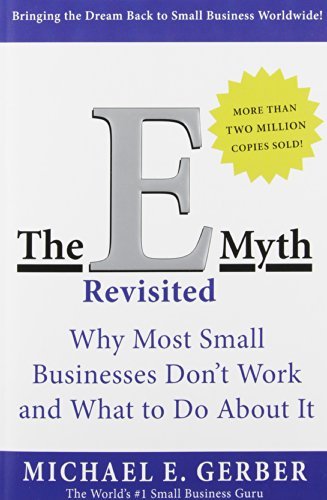
The author brutally points out the mistake of most of us: the fact that we are great at a certain activity (e.g., baking bread or designing gardens) does not mean we know how to run a business that does it. Gerber teaches that you must stop working IN the business and start working ON the business. This is the transition from an inspired artist to an efficient system operator.
Your First Step: The CEO’s Journal
How to implement this meticulousness from day one, when you have a thousand ideas in your head? My proven method is the CEO’s Journal. It is nothing more than a business diary kept with iron consistency.
Initially, your notes will be unstructured and disorganized. You will record failures, small successes, customer irritations, and your own mistakes. It doesn’t have to be literature. The most important thing is systematic approach. Why is it worth keeping?
Identifying Patterns: After some time, reading old notes, you (or anyone else) will see recurring problems. These points are candidates for creating the first procedure.
Paper Does Not Forget: Creativity is volatile and can be misleading—we often color the past. The Journal is a hard record of facts.
Support for a Consultant: If you ever hire a consultant or external manager, they won’t have to guess anything. Your journal is ready documentation of the “factual state”.
Foundation for Franchising: If you dream of scaling your company, you must have an operational journal. It doesn’t appear from inspiration in one weekend. It is created based on hundreds of notes, repeatedly corrected and tested in battle.
Evolution, Not the Ideal Idea
Forget about the “ideal idea” that appears in a flash of inspiration and immediately conquers the market. This is another myth of creativity. Real business is evolution. It is the daily improvement of small elements of the machine until it starts working flawlessly.Summary: Change the Definition of Success
True innovation is not about constantly painting new pictures on a clean canvas. It is about building an efficient machine that can replicate, optimize, and deliver these pictures to the recipient with predictable profit.
Creativity is a wonderful servant but a terrible master. If you allow it to take the helm, you will end up with a beautiful, artistic project that will sink under the weight of its own complexity. First, build the engine with hard procedures. Pour the concrete foundations of the strategy. And then, when everything is already working, add a little of that creative oil so you can go even faster.
Remember: No one wants to live in the most creative house in the world if its foundations crack at the first frost.